skip to main |
skip to sidebar
 [And yes it is!]I really enjoy reading Bill Bryson travel novels. I think its his laid back but intelligent approach to his subject(s) and to life in general. The first novel I read of his was The Lost Continent: Travels in Small-Town America - and loved the way he told of his travels in the USA, trying to find that fictional small town he grew up with when watching TV & movies in the 50's & 60's. Of course the hilarious thing is that the closest town he found that got to be looking and feeling like a real small town America was Provincetown! But I digress. A short history...continues his journey, but this time instead of travel its history [and what makes up everything in the universe] itself that is the journey dujour.Mr Bryson goes back and forth in his novel trying to give an oversight of the universe that is older than anyone can say, bigger than anyone can think and more unknown than the...well unknown itself. From the creation of the planets and the mighty milky way to the tiniest of bacteria, from modern health sustaining life to nuclear bombs taking it, the Cro-Magnon man to the species that is modern man, let alone insects, dinosaurs and the stuff of life - the lot! Bill draws from papers, people and all sorts of paraphernalia to paint the picture of what is known, [and in most cases than we like to think so] unknown about virtually everything.My love for this novel was the multiple subjects discussed and the way that we need to almost compact and change things so to suit circumstance rather than to accept that they just don't fit in a category. For example our solar system is always shown to suit text book page sizes so they fit all neatly, whereas the distance between the planets are so long that even reducing the earth to a pea on paper Jupiter is still 300 metres away...and you would need to standing in the next suburb to even get the chance to see Pluto! [Let alone if you make it real scale.] I also love the fact that when scientists and the so called 'people of knowledge' don't know, can't explain or find the missing links in history of life, they just make it up until someone knows, explains or find them [yes I'm not making that up either.]
Some of the subjects are not as interesting as others. While I found the solar system, universe and creation of the planets fascinating, I almost slept through the atom and elements chapter(s). However I am quick to point out it was only because it reminded me of high school chemistry lessons rather than the way Mr Bryson's places pen to the parchment [Mr Lee my chemistry teacher would be quite upset with me now] that sent me to sleepy by by's.But saying this, the book is just a really great read about...well the title suggests everything. Mr Bryson did win the Descartes Prize and also Aventis Prize from the science world. Apparently some top scientist was supposed to say that the book is "annoyingly free of mistakes" - however a list of errors made by the book is online for those wanting to doubt him. It's a shame that scientists with all their brilliance get just as much fun disproving people and ideas rather than trying and finding new ones. Maybe they should focus more on endeavours to finding those bloody missing gaps rather than just making it up.Regardless, you will be enlightened and enjoy this one.Four big bangs of out five.
 Michael Cunningham’s novel The hours was the connection of three women over different decades and how they manage with a day in their respective complex lives. It was well written and one of the few times that the film and the book were identical twins of one another. He writes in a style that is simple to read but it is not simple writing or subjects he is dealing with. Winning a Pulitzer prize is no simple feat.In Land’s end, a non fiction work, his writing style is again apparent. He pieces together an array of stories, prose, history and his own experiences of Provincetown (or P town as it’s known – another example of simplification of a word - the laziness of today). The writer was blessed with being a ‘P town’ resident for more than just a summer on the cape (unlike most vistors there).For those not in the know (or maybe I should say the ‘ho’) Provincetown is a gay (getaway) haven on the tip of the east coast of the USA. It’s a picturesque ex-fishing town full of salt box and cape cod cottages surrounded by the sea from all around as its at the end of a peninsula. Packed in summer and dead in winter, Michael literally writes about the town and its various incantations it takes on. Whether it is due to seasons, the remoteness, or just being the last stop at the (actual) end of the road this is not your average town.Now the older I’m getting the more I want to know about the history. In this book some interesting facts emerge. For example the site of P town was actually where the pilgrims first landed before Plymouth Rock. However let me stress this to you that this book is not an historical record more so an overview of the town. Personally I would have liked to have read more of it's past but the author points out that it is merely another facet of the town uniqueness. It is the accounts of the day to day running of the town that is the authors focus. From the A & P with gay cashiers (who double as drag queens at night) to the grand old town hall (the benches out the front used to be called the meat rack in the 70's), the old fishing wharf which was once the lifeblood of the town, the golden horde that is Marine Specialities (if you ever lost anything you’ll probably find it here) the ghost of art communes or simply the dunes, the sand and the sea, with all that interact with it.It’s a lovely read with its never ending cast of its residents, or should I say all the driftwood that has managed to float in and out the bay itself, some staying more than a summer. 4 pilgrims out of 5Thanks to the lovely Brigid lending me this copy.
 I was 19 when I first read the Tales of city series. For me it was like nothing I had ever read before. I loved all of the characters, and how their lives intertwined in such a lovely way. How they all were dancing to the same tune…just in different dance halls across the city. Almost a San Francisco symbiosis. That was almost 15 years ago. When Eddy (http://tummyguts.blogspot.com/) recently recommended this book for me I became quite excited. As a huge fan of Tales of the city it was the first book in ages that I actually rushed out to purchase for my reading pleasure (ok after the last Harry Potter novel).
Armistead Maupin continues the city tales after a break of more than 20 years...this time only focusing on Mouse - Mr Michael Tolliver. He's 55 now and alive, living with HIV and still being a big queen – or in Mouse’s eyes – a big Nellie/Mary/Fag.
Unlike the other novels this book is only from his perspective. Yes other characters are there but not like before. I don’t know if Armistead changed his writing style in the post AIDS world or has purposely decided not to use the usual format of inter-related stories/lives/characters. To be honest I was actually surprised that he even wrote this novel after a 20 year break – I thought he would have left this all behind (whether he produced this from his own doing or it was a requirement in a contract I don’t know) but the edge that Tales once had is lost – I don’t think it’s to do with his writing however more so a reflection of society in 2007.
Still though it’s a fairly good read. I like the fact the some of the old characters come back in…even though a few more have been killed off. And I do like the overall comment Armistead has made about gay life, getting older and the world today from an old 1960's baby boomer radicals perspective. For me it still hasn’t answered entirely the question of what happened to ? the many colourful and rich characters he created. Rather it’s a commentary of how the remaining have survived in a very different post-9-11-Bush-for-president-world to when they met and became family.
Three and a half hearts out of five.
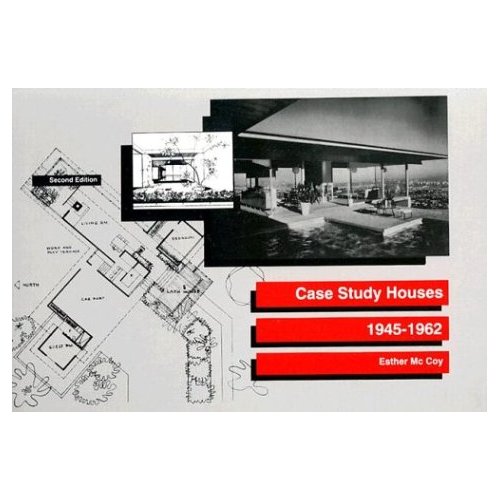
 I re-discovered a subject(bless Amazon)I have not thought about for over 10 years...in fact I completely forgotten about the Case study houses and how much they have influenced how we live today...
Back in 1945, John Entenza's Arts & Architecture magazine, commissioned major architects of the day, to design and build inexpensive and efficient model homes for the residential housing boom caused by the end of World War II and the return of millions of soldiers.
The houses are amazing to say the least - architects (Like Richard Neutra, Charles & Ray Eames for example)experimenting with materials from wood to steel to even plastic...creating open planned abodes with floor to ceiling doors & windows opening up these dwellings to natural light and views of the surrounds... or to the new to patio or terraces..from bedrooms with built in robes and furniture...to kitchens with all mod conds and bench seating...to ensuite bathrooms with double vanities...to open fireplaces, sunken rooms and split level floors - all of which we take for granted today...the indoor and outdoor blended, and the home started to take form and life ( or should I say 'lifestyle') of it's own - not just a art deco or colonial or Spanish mission revival box - it became a living functional machine...
The program ran from 1945 until the mid 60's. Most of the houses were built in California. The case study houses in their time started basic and pure, but ended up costly and a luxury item for rich americans...Was the idea of a low cost architectural abode lost?
Well yes and no...it exploded the idea of the traditional house - and the way we interact with it...in fact if you look at homes from the Mc Mansions of the new estate suburbs to the more expensive commisions some architects are lucky enough to create - all (yes even the ones which look like a copy of Tara) have used, abused and quite frankly stolen ideas from the case studies...that is the legacy which has survived.
'Case Study Houses 1945-1962' by Esther Mc Coy First published 1962, Reprinted 1977(NB - Originally written for an Review for Amazon)
 [And yes it is!]


 I re-discovered a subject(bless Amazon)I have not thought about for over 10 years...in fact I completely forgotten about the Case study houses and how much they have influenced how we live today...